
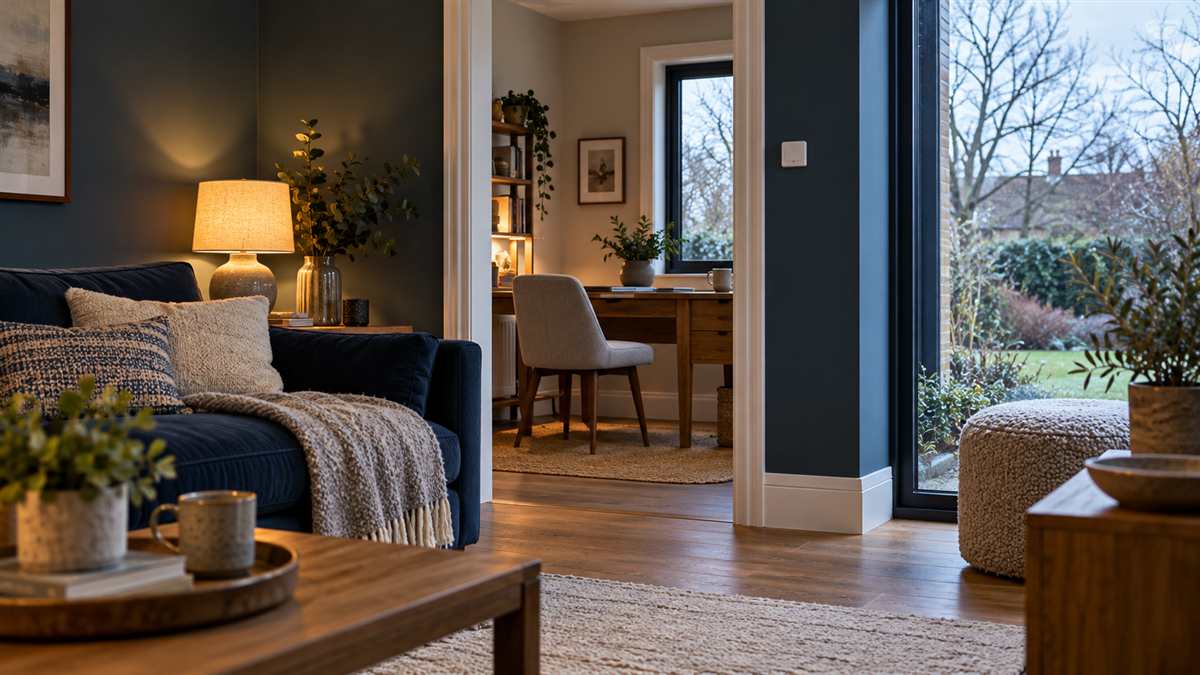
Zoned infrared heating lets you control warmth in different parts of your home around the way you actually live. A home office may need heating during the working day, while the living room becomes the priority in the evening.
This winter, start with a room-by-room plan: where you spend time, when you need comfort and how your home retains heat. Smart controls can help put that plan into practice, but good system design and sensible background settings still matter.
WARMTH THAT FITS YOUR DAY
What is zoned infrared heating?
Zoned infrared heating divides a property into separately controlled areas. Each zone has appropriate temperature control, so you can adjust its settings and heating schedule without giving every room the same timetable.
Infrared heating transfers radiant heat to people and surfaces in its surroundings. Energy Carbon’s concealed carbon-film heating systems can be incorporated into suitable ceilings, walls or compatible floor constructions. The proposed build-up, finishes and controls must be specified together.
A zone might be a bedroom, a home office or a larger living area. However, zones are not heat-proof boundaries: warmth moves between rooms, and open-plan spaces may need to be treated as one connected area. Read how infrared heating works for the underlying principles.
Use room-by-room heating to match comfort to occupancy, while maintaining suitable conditions throughout the building.
Working from home
Give the room you work in its own daytime schedule, allowing enough warm-up time before you sit down.
Family evenings
Plan for the spaces people share after school or work. Several occupied rooms may need comfort at the same time.
Changing routines
Keep a simple override for visitors, holidays and unexpected days at home. A schedule should be easy to adapt.
A PRACTICAL WINTER ROUTINE
Build a heating schedule around the rooms you use
Write down a typical weekday and weekend before choosing settings. Include when people get up, work at home, return in the evening and go to bed. The example below illustrates the approach; it is not a recommended temperature programme for every household.
| Time of day | Priority spaces | Planning approach |
|---|---|---|
| Morning | Bedroom and breakfast area | Schedule comfort for getting ready; allow for measured warm-up time. |
| Working day | Home office | Maintain comfortable working conditions and suitable background settings elsewhere. |
| Evening | Living room and other occupied rooms | Bring the spaces people use to comfort before they settle in. |
| Overnight | Bedrooms as needed | Use appropriate sleeping and background settings for the household and building. |
Allow time for the room to become comfortable
The response of infrared heating in winter depends on the installation, surface construction, heat loss and starting conditions. Concealed floor systems and ceiling systems can respond differently. Test the schedule and adjust the start time rather than assuming every installation warms a cold room immediately.
Consider how much of the home is occupied
A family of four in a small two-bedroom home may use a higher proportion of its rooms at once than one person living in a larger house. This occupancy diversity affects the opportunity to reduce unnecessary heating. If most rooms are occupied all day, the benefit of separate schedules may be smaller.
Comfort also depends on surrounding surfaces, not just the air temperature shown on a thermostat. Our guide to mean radiant temperature and home comfort explains why a room can still feel cool beside cold walls or glazing.
MAKE CONTROL SIMPLE
Smart heating controls: useful features for winter
Look for controls that make electric heating zones straightforward to manage. Independent schedules, clear temperature settings and an easy temporary override are often more useful than a complicated collection of features.
Choose compatible room controls
Ask your installer how each thermostat senses temperature, where it should be positioned and whether floor or surface sensors are required. Direct sunlight, draughts and nearby heat sources can affect readings. Confirm electrical compatibility and any switching or power-supply requirements before buying controls.
Use time-of-use electricity tariffs thoughtfully
A compatible smart control system may help shift some operation into lower-priced periods. However, a cheaper unit rate does not automatically mean a cheaper heating bill: warming rooms earlier can increase heat losses, and some constructions store little useful heat. Check whether the proposed system can retain warmth until you need it.
Compare consumption and cost across the whole day, including expensive periods. Solar electricity can contribute when generation coincides with demand, but it should not be assumed to cover winter heating. Other heating technologies can also use smart controls and flexible tariffs.
The Energy Saving Trust’s guide to heating controls explains how thermostats and programmers can support a more suitable heating routine.
KEEP THE NUMBERS REALISTIC
Can room-by-room heating reduce running costs?
It can reduce unnecessary heating when a well-designed schedule replaces heating spaces that do not need the same level of warmth at the same time. The result depends on your previous heating pattern, insulation, weather, occupancy and electricity tariff. There is no universal percentage saving.
For a useful comparison, record energy use over comparable periods and note outdoor conditions and changes in occupancy. An app’s scheduled hours are not necessarily hours of continuous electricity use: thermostats may switch the system on and off.
Our guide to infrared heating running costs includes worked examples and explains how to estimate the complete system’s electricity consumption. Include controls and power-supply losses where relevant.
Compare alternative systems fairly. A heat pump can deliver the same amount of useful heat using less electricity than direct electric heating but takes longer to react and will need to be running continuously. Installation costs, hot water, the building and the rooms you intend to heat all belong in the decision; zoning alone does not establish which system will be cheapest.
BEFORE THE COLD SPELL
Your winter heating planning checklist
- Map your routine. List occupied rooms, weekday and weekend patterns, and any household comfort needs.
- Check the building. Address draughts and insulation opportunities without blocking required ventilation.
- Request room-by-room heat-loss calculations. Choose capacity for the room’s requirements rather than floor area alone.
- Agree the installation and controls. Confirm suitable surfaces, coverage, sensors, electrical design and accessible user controls.
- Trial the schedule. Observe warm-up times and comfort, then make small adjustments as the weather changes.
- Review the whole bill. Compare electricity consumed and tariff periods, alongside comfort and indoor conditions.
Keep less-used rooms in suitable condition
Do not treat zoning as a reason to leave parts of the home cold for long periods. Appropriate background warmth and ventilation help manage condensation risk. Consider the building and the needs of children, older people or anyone who needs warmer conditions when agreeing settings.
Persistent damp needs its cause investigated. Heating is not a substitute for fixing leaks or providing suitable ventilation. See the Energy Saving Trust’s damp and condensation guidance.
COMMON QUESTIONS
Zoned infrared heating FAQs
Can I heat just my home office during the day?
You can prioritise home office heating with a separately controlled zone. Keep other rooms at suitable background settings and account for heat transfer through open doorways or shared walls. The right approach depends on your home and household.
Should I turn unused rooms off completely?
Not as a general winter rule. Rooms left cold for long periods can develop condensation problems, and adjoining spaces lose heat into them. Agree suitable background settings and ventilation for your building.
Do I need an app for zoned heating?
No. Compatible programmable room controls can provide separate schedules without an app. Smart features can make changes easier, but simple, accessible controls are the priority.
Does zoning make infrared heating cheaper than a heat pump?
Not automatically. Compare useful heat, the spaces being heated, electricity use, tariffs and installation costs. Heat pumps can also have zoning and smart controls, and typically use less electricity for the same heat output.
PLAN YOUR WINTER COMFORT
Explore a heating plan for your home
Bring your floor plan, room-use pattern and project details to Energy Carbon. Discuss suitable carbon-film applications, room controls and the information needed for a tailored system proposal.
Discuss your heating project