
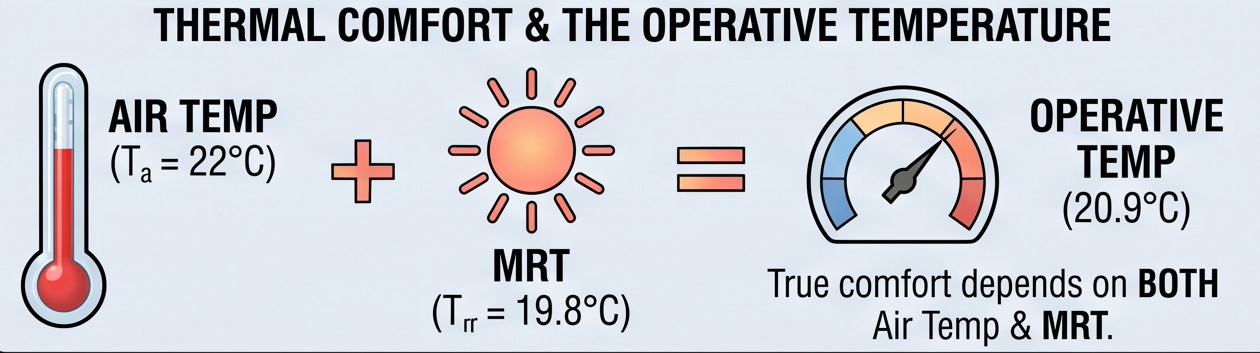
ENERGY CARBON GUIDE What Is Mean Radiant Temperature? Why a Warm Room Can Still Feel Cold A thermostat measures the air at one point. Your body experiences the whole room: the air, the temperature of nearby walls, windows, floor and ceiling, air movement, humidity, clothing and activity. That is why a UK home can read 20°C or 21°C and still feel chilly. Mean radiant temperature helps explain the gap — and why insulation, glazing, draught control, heating layout and radiant heating all need to be considered together. Planning a heating project? Energy Carbon can review the building, room-by-room heat loss, available surfaces and control strategy before a system is specified. Request a consultation See how infrared heating works Comfort model · illustrative 18°Coperative feel 21°Cair 15°Csurfaces THE QUICK ANSWER Mean radiant temperature in plain English Mean radiant temperature is a single value used to represent the combined thermal effect of the surfaces around you — including walls, windows, the floor, ceiling and large objects. If those surfaces are cold, your body loses heat to them by radiation and the room can feel colder than the air-temperature reading suggests. If the surrounding surfaces are warmer, the same air temperature may feel more comfortable. What is operative temperature? Operative temperature is a comfort measure that combines air temperature and mean radiant temperature, with air movement also affecting the balance. In calm indoor conditions, a simple illustration is to treat it as roughly the average of air temperature and mean radiant temperature. For example, if the air is 21°C but the surrounding surfaces average about 15°C, the operative temperature may feel closer to 18°C. This is an illustration, not a substitute for a professional comfort assessment: actual conditions vary by position, air speed, surface area and exposure. In calm indoor conditions 21°+15°÷ 2 Approximate operative temperature: 18°C Illustration only. Professional assessment accounts for surface geometry, air speed and position. COMFORT IS A SYSTEM The thermostat is only one part of thermal comfort The Health and Safety Executive identifies six basic factors that influence thermal comfort. Four relate to the environment and two relate to the person. For homes as well as workplaces, the framework is a useful reminder that one thermostat reading cannot describe everyone’s experience. Factor What it means Why it matters in a room Air temperature The temperature of the air around you It is what most wall thermostats measure. Radiant temperature The thermal effect of surrounding surfaces Cold glazing or walls can make you lose heat even when the air is warm. Air movement How quickly air passes across the body Draughts can increase heat loss and make cool conditions feel colder. Humidity The amount of moisture in the air It affects evaporation and comfort, but heating must not replace adequate ventilation. Clothing The insulation provided by what you wear People in the same room may need different conditions. Activity The heat produced by the body Someone working at a desk usually feels cooler than someone moving around. The useful design target is not simply a high air temperature. It is an indoor environment with an appropriate operative temperature, limited draughts and no uncomfortable radiant hot or cold spots. DIAGNOSE THE ROOM Why does a room feel cold when the thermostat says 21°C? Cold walls, windows and floors A large cold surface lowers the mean radiant temperature near it. This is often noticeable beside older glazing, uninsulated external walls, solid floors and poorly insulated roof slopes. The closer you sit to the surface, the stronger the effect may feel. A thermostat in the wrong place A thermostat reports the conditions where it is installed. A warm hallway, direct sunlight, a nearby appliance or a location shielded from the coldest part of the room can cause it to stop the heating before the occupied area feels comfortable. Draughts and air leakage Air leaking around doors, windows, loft hatches or service penetrations can increase convective heat loss from the room. Draught-proofing can help, but deliberate ventilation must remain effective and combustion appliances must never be deprived of required air. Uneven heat distribution A room can contain warm air near the emitter or ceiling and cooler conditions where people sit. Large spaces, high ceilings, cold façades and obstructed heat emitters all make layout and output important. Different people, different comfort Age, health, clothing, activity and personal preference influence thermal sensation. If someone feels persistently cold when others are comfortable, the building may not be the only factor and appropriate medical advice may be sensible. RADIANT HEATING EXPLAINED How infrared surface heating changes the comfort equation Infrared heating is a form of radiant heating. It transfers a larger share of its heat to exposed people and surfaces rather than relying only on warming and circulating air. Those warmed surfaces then exchange heat with occupants and also warm the room air by convection. Energy Carbon uses ultra-thin carbon-film elements that can be integrated into suitable ceilings, walls and compatible floors. Spreading the emitter across an appropriate surface area can support broad radiant coverage while keeping the heating concealed. Radiant heating is not a shortcut around building physics The result still depends on room-by-room heat loss, emitter output, surface selection, coverage, controls, occupancy and the building fabric. A poorly insulated or very draughty room continues to lose heat. Furniture, finishes and room geometry may also affect what the emitter can reach. The 2025 UK government review of domestic infrared heating found that line of sight was especially important in its short user trials. It also concluded that the evidence base for real-world energy savings remains limited. Infrared should therefore be assessed as a project-specific heating option, not sold on a universal savings percentage. Explore the technology before choosing it See Energy Carbon’s system explanation and product formats, then request a room-by-room assessment for your building. How it works View carbon-film products WHAT TO CHECK Problems that heating alone should not be expected to solve Persistent condensation or mould. Although a well placed infrared system can

How Thermal Comfort Affects Wellbeing at Home
Energy Carbon Guide How Thermal Comfort Affects Wellbeing at Home Most people think a comfortable home is simply one that’s warm enough. In reality, thermal comfort is about much more than the temperature shown on your thermostat. It is the way your entire indoor environment makes you feel, combining warmth, humidity, air movement, surface temperatures and the way heat is distributed throughout your home. A house can technically be heated to 21°C and still feel cold if there are draughts, cold walls or uneven temperatures between rooms. Likewise, a well-designed heating system can often make a room feel more comfortable without needing to increase the thermostat significantly. Comfort beyond temperature Understanding Thermal Comfort at Home Thermal comfort has become increasingly important across the UK as homeowners look for healthier, more energy-efficient ways to heat their properties. Whether you’re renovating an older home, improving insulation or considering modern heating technologies, understanding thermal comfort can help you make better decisions for both your wellbeing and your property. In this guide, we’ll explain what thermal comfort really means, why it matters, and how creating a balanced indoor environment can improve everyday life. Balanced warmth, throughout the room The complete picture What Is Thermal Comfort? Thermal comfort is the condition where a person feels neither too hot nor too cold within their surroundings. It isn’t determined by air temperature alone. Instead, it is influenced by a combination of environmental and personal factors that affect how our bodies gain and lose heat. Because everyone experiences temperature differently, there is no single “perfect” room temperature for every household. However, creating a stable and balanced indoor environment helps most people feel comfortable throughout the day. These factors include: Air temperature Surface temperatures of walls, floors and ceilings Humidity levels Air movement Clothing Activity levels Individual preference Everyday quality of life Why Thermal Comfort Matters More Than You Think A comfortable home isn’t simply about luxury. It influences how we relax, work, sleep and enjoy our living spaces. Many people spend the majority of their time indoors, particularly during the colder months. If parts of the home always feel chilly or draughty, occupants often find themselves turning the heating up, adding extra layers or avoiding certain rooms altogether. Good thermal comfort allows every room to feel consistently usable and welcoming, helping households make better use of their living space. How the home feels The Link Between Thermal Comfort and Wellbeing Our homes should provide an environment where we can unwind after work, enjoy time with family and get a good night’s sleep. When indoor conditions feel uncomfortable, it can become harder to fully relax. It’s important to recognise that wellbeing depends on many different factors. Heating alone cannot determine health or wellbeing, but it plays an important role in creating an environment where people feel comfortable throughout the year. A balanced indoor environment can contribute to: Better quality sleep Improved comfort while working from home A more enjoyable living environment Greater satisfaction with the home Reduced need to constantly adjust heating controls Air temperature is only one factor Why Some Homes Feel Cold Even When the Heating Is On One of the most common complaints from homeowners is: “My thermostat says 21°C, but I still feel cold.” This usually happens because air temperature is only one part of thermal comfort. Cold walls, single glazing, poorly insulated floors and draughts all absorb heat from our bodies, making us feel colder than the thermostat suggests. Similarly, if warm air quickly rises to the ceiling while colder air remains around seating level, the room may never feel consistently comfortable. This is why improving the building fabric and choosing an appropriate heating solution often has a greater impact than simply increasing the thermostat setting. The building and the heating system Common Factors That Affect Thermal Comfort Several elements work together to determine how comfortable your home feels. Insulation Well-insulated homes lose heat more slowly, helping to maintain a stable indoor temperature. Air Leakage Uncontrolled draughts can create uncomfortable cold spots and increase heating demand. Humidity Very dry or overly humid air can reduce comfort, making rooms feel less pleasant throughout the year. Surface Temperatures Cold windows, walls and floors draw warmth away from occupants even when the surrounding air feels warm. Heating Design How heat is delivered throughout a room has a significant impact on overall comfort. Control warmth around daily life How Modern Heating Systems Support Better Comfort Modern heating solutions focus on delivering consistent warmth while giving homeowners greater control over how individual rooms are heated. Features such as programmable controls, zoning and responsive heating schedules allow households to tailor heating around daily routines instead of heating the entire property continuously. This approach can improve comfort while helping households use energy more effectively. Radiant warmth Where Infrared Heating Fits In Unlike traditional heating systems that primarily warm the air, infrared heating works by gently warming people and surrounding surfaces through radiant heat. This approach can create a more balanced feeling of warmth throughout a room by reducing cold surfaces and improving overall thermal comfort. As with any heating solution, performance depends on factors such as insulation, room design, heat loss and correct system specification. Infrared heating is therefore best considered as part of an overall strategy for creating a comfortable and energy-efficient home. Even distribution matters Symmetry is key in a room and so, to avoid cold areas, the infrared should be spread evenly across the room. Find out how infrared carbon heating works Practical improvements Simple Ways to Improve Thermal Comfort Improving thermal comfort doesn’t always require major renovation work. Small changes can make a noticeable difference. Together, these measures help create a more stable indoor environment that feels comfortable throughout the year. These include: Improving insulation where practical Reducing unwanted draughts Maintaining effective ventilation Using programmable heating controls Heating occupied rooms appropriately Choosing heating systems suited to the property Keeping windows and doors well maintained Heating approach comparison Comparison Table: Traditional Heating vs Infrared Heating Feature Traditional
The Rush to Electrification: What It Means for UK Heating
UK Heating Future The Rush to Electrification: What It Means for UK Heating UK Prime Minister announced that the UK is at the right point to adopt a ‘Rush To Electrification’ to rapidly move households off of gas and onto the electricity grid, but what does this actually mean and how practical is it? The UK heating conversation is changing quickly. For years, the focus has been on improving boiler efficiency, reducing heat loss and making homes cheaper to run. Now, a bigger issue is coming into view: how much the UK still depends on fossil fuels for heating. Gas boilers remain common across British homes, while many rural and off-grid properties still rely on oil boilers. These systems have been familiar and practical for decades, but global energy uncertainty, climate targets and changing government policy are pushing the UK towards a more electric future. What does the rush to electrification mean? This shift is often described as the rush to electrification. In simple terms, it means moving more of our heating, transport and home energy use away from fossil fuels and towards electricity, especially as the electricity grid becomes cleaner. For homeowners and businesses, the question is no longer only about replacing a boiler. It is about understanding what future-ready heating looks like, how energy security affects everyday costs, and where technologies such as infrared heating may fit into the wider move towards clean heat. The UK Government’s Warm Homes Plan describes home electrification through solar panels, batteries and clean heat as a route away from volatile international fossil fuel markets. It also sets out plans for investment in home upgrades, clean heat and energy efficiency. UK Heating Future From fossil fuels to electric homes What Is the Rush to Electrification? The rush to electrification is the growing move away from fossil fuel systems such as gas and oil towards electric technologies. In UK heating, this includes clean heat systems, heat pumps, infrared heating, solar panels, battery storage and smarter energy use. A cleaner direction for UK homes The aim is to reduce fossil fuel dependence, improve energy security and support lower-carbon homes without making heating decisions feel confusing for property owners. Why Electrification Is Becoming a Major UK Heating Topic Electrification is not just a technical trend. It is becoming part of a bigger national conversation around energy security, affordability and sustainability. The UK imports and trades energy in a global market. When oil and gas supplies are disrupted by conflict, political instability or supply chain pressure, prices can rise sharply. This affects households, businesses and public buildings. Energy Security Electric heating can reduce reliance on imported fossil fuels as the UK grid becomes cleaner. Off-Grid Homes Rural properties using oil, LPG or delivered fuels can be more exposed to fuel price changes. Practical Advice Homeowners need realistic guidance on which heating option suits their building and lifestyle. Homes that are not connected to the gas network can be particularly exposed. Many of these properties rely on oil boilers, LPG or other delivered fuels. When global fuel prices rise, these homes often feel the pressure quickly. For the heating industry, this creates an important moment. Property owners need clear advice, not panic. They need to understand what is changing, what is realistic, and which heating options may suit their building. Speak to Energy Carbon What Does Electrification Mean for Gas and Oil Boilers? Electrification does not mean every gas boiler is disappearing overnight. Existing homeowners are not being forced to remove working boilers immediately. However, the direction of travel is clear. New homes, building standards and government support are increasingly focused on clean heat, energy efficiency and electric-ready properties. Gas boilers have been the default heating system in the UK for decades. Oil boilers have also played an important role in rural and off-gas-grid homes. The challenge is that both depend on fossil fuels. Heating Transition Gas, oil and the move towards electric heat This creates three long-term issues for UK homeowners, landlords and commercial property owners: 1. Price Volatility Oil and gas prices are influenced by global markets. When international supply becomes uncertain, households can face higher heating costs. 2. Carbon Emissions Heating buildings remains a major part of the UK’s carbon challenge. Homes and buildings are responsible for a significant share of UK emissions, which is why clean heat and energy efficiency are becoming more important. 3. Future Regulations As new standards develop, homes and commercial buildings may increasingly be expected to move towards cleaner, more efficient heating options. The key point is simple: Electrification is not only about replacing boilers. It is about preparing buildings for the next stage of UK heating. UK Heating Costs Why Electricity Costs Are Part of the Debate One reason the move to electric heating creates debate is the difference between gas and electricity prices. Many homeowners worry that electric heating will automatically cost more to run. This concern is understandable, especially when electricity unit prices have often been higher than gas. The government has acknowledged that relative gas and electricity prices affect the adoption of clean heat. This is why the heating conversation needs to be honest. Electric heating is not one single technology. A heat pump, an electric radiator, a storage heater and an infrared heating system all work differently. Honest planning matters Electrification should not be sold as a simple one-size-fits-all solution. It should be planned around the building, the people using it and the way heat is actually needed day to day. The Right System Depends On ✓ Property type and building age ✓ Insulation level and heat loss ✓ Daily usage pattern ✓ Existing heating setup ✓ Room layout and zoning needs ✓ Control strategy and heating schedule ✓ Energy tariff and running cost expectations ✓ Whether solar or battery storage is available For Energy Carbon, this is where practical advice matters. The best heating choice is not only about the fuel source. It is about matching the system to the building, the budget,
Can Infrared Heating Work in Old UK Homes?
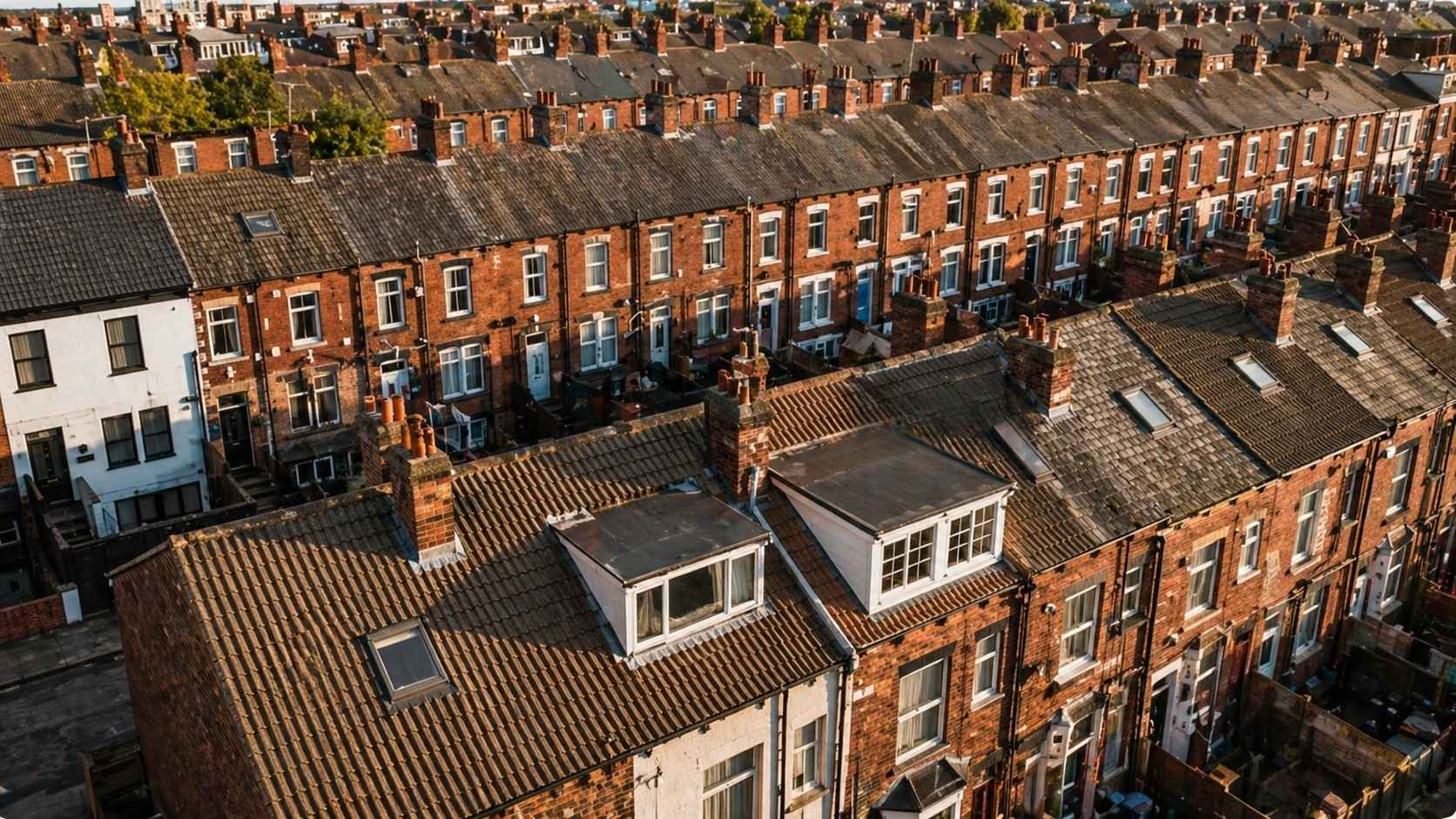
Can Infrared Heating Work in Old UK Homes? The UK has some of the oldest housing stock in Europe. From Victorian terraces and Edwardian townhouses to countryside cottages and heritage buildings, millions of British homes were built long before modern heating systems existed. While these properties often offer character and charm, they can also present challenges when it comes to heating efficiency, insulation, and thermal comfort. As energy conversations continue to evolve across the UK, many homeowners are now exploring whether modern systems like infrared heating can work effectively in older properties. The answer depends on the building itself, but in many situations, infrared heating is becoming part of the conversation around flexible, low-maintenance, and future-focused heating solutions. Why Older UK Homes Can Be Difficult To Heat Many traditional British homes were designed during periods when energy efficiency standards were very different from today. Common challenges include: Solid walls Drafts Cold surfaces Uneven room temperatures Limited insulation High ceilings Older windows Traditional heating systems often attempt to heat large volumes of air, which can sometimes lead to inconsistent comfort levels in older buildings. This is why homeowners increasingly look for heating approaches that focus not only on air temperature but also on overall thermal comfort. How Infrared Heating Works Differently Infrared heating operates differently from traditional convection-based systems. Instead of mainly heating the surrounding air, infrared systems warm surfaces and objects within the room. This can help create a more balanced feeling of warmth throughout the space. For older UK homes, this approach may offer several practical advantages: Flexible installation options Minimal maintenance Quiet operation Reduced reliance on pipework Improved radiant comfort Because many older properties have architectural limitations, homeowners often value heating systems that can adapt more easily to different layouts and building structures. Can Infrared Heating Improve Thermal Comfort? One of the biggest discussions in modern heating is thermal comfort. A room may technically reach a warm air temperature while still feeling uncomfortable if: Walls remain cold Floors lose heat Window surfaces stay chilly Heat distribution is uneven Infrared heating focuses more on radiant warmth and surface comfort, which is why many homeowners describe the feeling differently from traditional heating systems. This can be particularly relevant in older buildings where retaining balanced warmth is often more challenging. Is Infrared Heating Suitable For Heritage Properties? Every building is different, and heating suitability depends on several factors: Property condition Insulation quality Building layout Electrical infrastructure Usage patterns However, infrared heating is increasingly being explored across: Victorian homes Listed properties Churches Converted buildings Offices Heritage renovations In some situations, the flexibility of infrared systems can make them attractive where traditional retrofit work may be more disruptive. Professional assessment remains important before making any heating decisions. Infrared Heating vs Traditional Heating in Older Homes Feature Traditional Gas Heating Infrared Heating Main Heating Style Heats air Radiant warmth Pipework Requirement Often extensive Minimal Maintenance Regular servicing Low maintenance Installation Flexibility More restricted Flexible options Surface Warmth Indirect Direct radiant comfort Suitability For Heritage Spaces Varies Increasingly explored The Future Of Heating Older UK Homes As the UK moves towards more sustainable heating solutions, homeowners are increasingly exploring technologies that combine: Comfort Practicality Energy awareness Long-term flexibility Older homes will always come with unique heating challenges, but modern systems are helping expand the options available. Infrared heating for homes is now becoming part of the wider conversation around future-ready heating, especially in buildings where comfort, aesthetics, and installation flexibility matter. Final Thoughts As more UK homeowners look for sustainable and flexible heating options, infrared heating UK homes discussions are continuing to grow — particularly in older and heritage properties where traditional heating upgrades can be more complex. Explore Modern Heating Solutions For Older UK Homes Whether you own a Victorian terrace, countryside cottage, or heritage property, our team can help you explore practical heating solutions designed for comfort and long-term efficiency. Get Free Heating Advice FAQs Can infrared heating work in Victorian homes? Yes, infrared heating is increasingly being explored for Victorian and older UK homes due to its flexible installation options and radiant heating approach. Is infrared heating suitable for listed buildings? Suitability depends on the property, but infrared systems are often considered in heritage projects where minimal disruption is important. Does infrared heating replace radiators? In some cases, infrared heating may be used instead of traditional radiators, depending on the heating design and property requirements. Will I need a plant room? No, unlike boilers and heat pumps, there is no bulky equipment to site. Just a hot water tank or instantaneous hot water, such as Quooker Why do older homes feel cold even when heating is on? Cold walls, drafts, poor insulation, and uneven heat distribution can all affect thermal comfort inside older buildings. Is infrared heating low maintenance? Infrared heating systems are generally considered low maintenance because they contain fewer moving parts than traditional wet heating systems. See All Faqs
Which Heating System Requires the Least Maintenance?
Which Heating System Requires the Least Maintenance? When choosing a heating system for a UK home, efficiency and running costs are often the main focus. But maintenance is just as important. Some systems require regular servicing, mechanical repairs, and ongoing upkeep, while others are designed to operate with minimal maintenance over many years. Understanding these differences can help homeowners make a more informed long-term decision. Why Older UK Homes Can Be Difficult To Heat Maintenance affects: long-term running costs reliability disruption to your home system lifespan A heating system that requires frequent servicing or repairs can become expensive over time, even if the initial installation cost is lower. This is one reason many UK homeowners are now exploring modern alternatives with simpler system designs. Comparing Heating System Maintenance Gas Boiler Systems Gas boilers are widely used across the UK, but they require ongoing maintenance to operate safely and efficiently. Typical maintenance includes: Annual servicing Boiler pressure checks Pipework inspections Valve and radiator maintenance Over time, components can wear down, and repairs may become more frequent. Heat Pumps Heat pumps generally require less maintenance than boilers, but they still involve mechanical components and external units. Maintenance may include: Filter cleaning Refrigerant checks Fan inspections System servicing Checking smart control settings They are efficient systems, but professional servicing is still recommended. Infrared Heating Systems Infrared heating systems are designed differently from traditional heating systems. Because they operate without boilers, pumps, moving mechanical parts, or circulating water, maintenance requirements are significantly reduced. Typical maintenance includes: Checking smart control settings This simplicity helps reduce long-term servicing requirements and lowers the risk of mechanical failure. Heating System Maintenance Comparison Table Heating System Maintenance Level Annual Servicing Moving Parts Gas Boilers High Usually Required Many Heat Pumps Medium Recommended Some Infrared Heating Low Rarely Required Minimal Why Low Maintenance Matters in Modern Homes Modern homeowners are increasingly looking for systems that are: reliable energy efficient easy to manage long-term Lower maintenance means: fewer unexpected costs less disruption improved long-term reliability This is one reason why infrared heating is becoming more attractive in modern UK properties. Why Energy Carbon Focuses on Infrared Heating Solutions At Energy Carbon, we focus on heating systems designed around long-term performance, simplicity, and thermal comfort. Our infrared heating solutions are developed to provide: efficient radiant heating reduced maintenance requirements improved control and zoning long operational lifespan Rather than relying on complex mechanical systems, infrared heating delivers warmth more directly and with fewer components that require ongoing upkeep. This makes it a practical option for many modern homes and commercial spaces. FAQs Does infrared heating need servicing? In most cases, infrared heating systems require very little servicing compared to boilers. Which heating system requires the least maintenance? Infrared heating systems generally require the least maintenance due to their simple design and minimal moving parts. Are heat pumps lower maintenance than boilers? Yes, but they still require periodic servicing and system checks. How long do infrared heating systems last? Many infrared systems are designed for operational lifespans of 50+ years. See All Faqs Final Thoughts Choosing the right heating system is not just about installation costs or efficiency ratings. Maintenance, reliability, and long-term simplicity also play a major role. For homeowners looking to reduce servicing requirements and improve day-to-day comfort, infrared heating offers a practical low-maintenance alternative worth considering. Still Not Sure Which Heating System Is Right? Upgrade your home heating and start saving on energy bills.Get expert advice tailored to your property. Get Free Heating Advice
Best Heating System for UK Homes in 2026
What is the Best Heating System for UK Homes in 2026? The best heating system for UK homes in 2026 depends on efficiency, running costs, and how heat is delivered. Heat pumps and infrared heating are leading choices due to their energy efficiency, while traditional gas systems are becoming less attractive due to rising costs. Modern systems focus on comfort, control, and long-term savings rather than just heat output. Why Choosing the Right Heating System Matters Heating is one of the biggest ongoing costs for UK households. With energy prices continuing to fluctuate, choosing the right system is no longer optional. It directly affects your monthly bills, comfort levels, and long-term property value. Modern homeowners are now prioritising systems that deliver consistent warmth while using less energy. This shift is driving the move away from traditional gas systems towards more efficient and controllable solutions. Types of Heating Systems in UK Homes Gas Central Heating Gas central heating has been the standard for many years. Pros: Reliable and familiar Strong heat output Cons: Increasing running costs Higher carbon emissions Heat loss through air circulation Electric Central Heating Includes panel heaters and electric radiators. Pros: Easy to install No gas required Cons: Higher electricity costs Less efficient heat retention Heat Pumps (Air & Ground Source) Heat pumps are widely promoted as highly efficient systems Pros: Low energy consumption Eco-friendly Government incentives available Cons: High installation cost Performance depends on external conditions Infrared Heating vs Heat Pumps – Efficiency Explained When comparing heating systems in the UK, efficiency is often misunderstood. Heat pumps are commonly advertised as being over 300% efficient. This is because they transfer heat rather than generate it, meaning they can produce more heat energy than the electricity they consume. Infrared heating systems UK, on the other hand, operates at around 98% to 100% efficiency. At first glance, this may seem lower, but the way infrared heat works creates a different kind of performance in real-world conditions. Instead of heating the air, infrared systems heat surfaces such as walls, floors, and furniture. These surfaces then release heat gradually, creating a more stable and consistent indoor environment. This approach reduces heat loss, especially in UK homes where warm air from traditional systems often escapes through windows and ceilings. Another key advantage is control. Infrared heating allows precise zoning, meaning you only heat the spaces you actually use. This reduces overall energy demand and improves system efficiency. When it comes to thermal comfort, infrared heating performs strongly because it supports all four key factors: Air temperature Radiant temperature Air movement Humidity balance Why Infrared Heating is Growing in the UK Infrared heating is gaining attention because it aligns with how modern homes are used. It delivers: Consistent warmth Reduced energy waste Better comfort at lower temperatures In many cases, homeowners feel warmer even when the thermostat is set lower. This can result in noticeable savings over time. Best Heating System Based on Home Type Small Flats Electric or infrared systems are ideal due to easy installation and control. Medium Homes Infrared heating offers a balance of efficiency and comfort. Large Homes Heat pumps or hybrid systems provide long-term efficiency benefits. Key Factors to Consider Before Choosing Property size and layout Insulation quality Installation budget Long-term running costs Heating usage habits There is no one-size-fits-all solution. The best system depends on how your home is used daily. Heating System Comparison (UK 2026) System Efficiency Running Cost Best For Gas Heating Medium High Older homes Electric Heating Medium High Flats Heat Pumps High Low Eco-focused homes Infrared Heating High Low Modern homes FAQs What is the most energy-efficient heating system in the UK? Heat pumps and infrared heating systems are among the most efficient options available. Is infrared heating cheaper than gas? In many cases, yes. It reduces heat loss and improves energy efficiency, lowering running costs. Are heat pumps worth it in the UK? Yes, especially for long-term savings and environmentally friendly homes. Which heating system is cheapest to run in the UK? Infrared heating and heat pumps are generally the most cost-effective over time. See All Faqs Final Thoughts The best heating system for UK homes in 2026 is no longer just about heat output. It is about efficiency, comfort, and long-term savings. Traditional systems still have their place, but modern solutions like infrared heating and heat pumps are leading the shift towards smarter, more efficient homes. Choosing the right system today can significantly reduce energy bills and improve living comfort for years to come. Still Not Sure Which Heating System Is Right? Upgrade your home heating and start saving on energy bills.Get expert advice tailored to your property. Get Free Heating Advice
Solving mould and damp in older properties that have been insulated
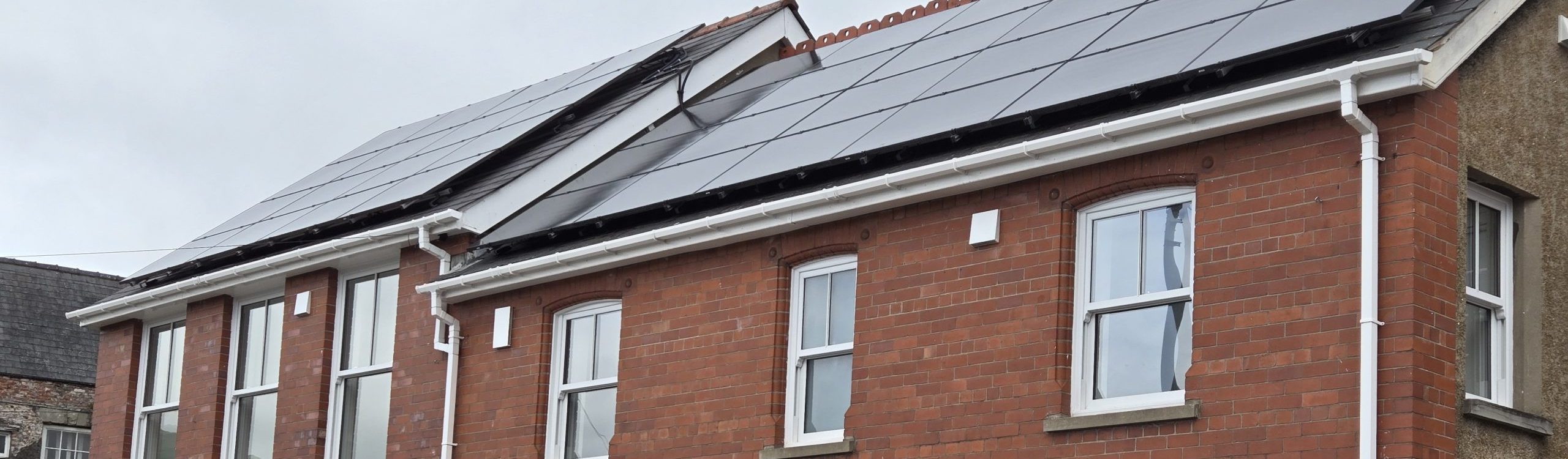
The “Tea Cosy” Problem: How to Solve Mould & Damp in Older Insulated Properties When we aim to reduce energy and carbon in our older homes, we often pop a ‘tea cosy’ over it with EWI and/or IWI to trap the heat inside. This results in a warm home, but moisture builds up, and mould and stale air become an even worse issue. The problem is that it’s too cold to open windows, which defeats the purpose of the insulation, but daily life still creates steam and moisture that has nowhere to escape bringing mould and damp in older properties Understanding the Science of Mould & Condensation The warm air circulates, and its molecules, swollen with water, bounce off colder surfaces like a window or an external wall. The air molecule immediately shrinks and spills its contents, which leeches into the plasterwork. This creates the perfect environment for mould spores, which are dragged in on our clothes and shoes or via pets, to germinate and spread. In desperation, walls are bleached, which merely masks the issue, and windows are opened, allowing more spores and moisture in along with pollutants. Solution 1: Low-Temp Surface Heating Instead of heating the air, there is a solution that heats surfaces first. When used at the correct frequency on the ceiling and over a large surface area, this “light” heats the surfaces without immediately warming the air. The air molecules remain restricted and simply bounce off the warmer walls. The “light” also penetrates deep into the walls to dry out any damp within them. As the walls retain the heat energy, they continue to warm the room even when the “light” is switched off. For stubborn areas, the light can even be emitted from within the wall itself, keeping the surface above the “dew point” and drying out any moisture. Solution 2: Preventing condensation in old buildings with Mechanical Ventilation Systems Daily activities still create moisture that builds up. A traditional centralized MVHR (Mechanical Ventilation with Heat Recovery) system would extract this and send it out of the roof, retaining the heat and then bringing in fresh, filtered and warmed air back in. Unfortunately, these systems are expensive, take up a lot of space, and require extensive ducting to be run throughout the home to collect the ‘bad’ air. This is not so bad in a new build, even though many house builders still refuse to fit them, but very hard to retrofit into older properties. Instead of sending the stale air upwards, a more compact solution sends it outwards. These “through-wall” units consist of carefully positioned 200mm to 300mm long ducts that are placed through external walls. Each duct has a high-density ceramic core and two reversible fans that work silently and continuously. These units use just 2 watts of power and recover around 98% of the heat. Each unit also has a sensor that monitors moist air and foul air and can let a central hub know if the room needs to be purged. A dual-fan, through-wall unit uses just 2 watts of power and recovers around 98% of the heat. The Complete Solution to Damp & Mould in older properties Moisture control through ventilation and low-temperature surface heating is our bread and butter, thanks to German engineering and over 60 years of experience in the European sector. To find out more about our energy-efficient surface heating and ventilation solutions, please get in touch.
Case study – Warksburn Old Church Luxury Passivhaus Holiday Home
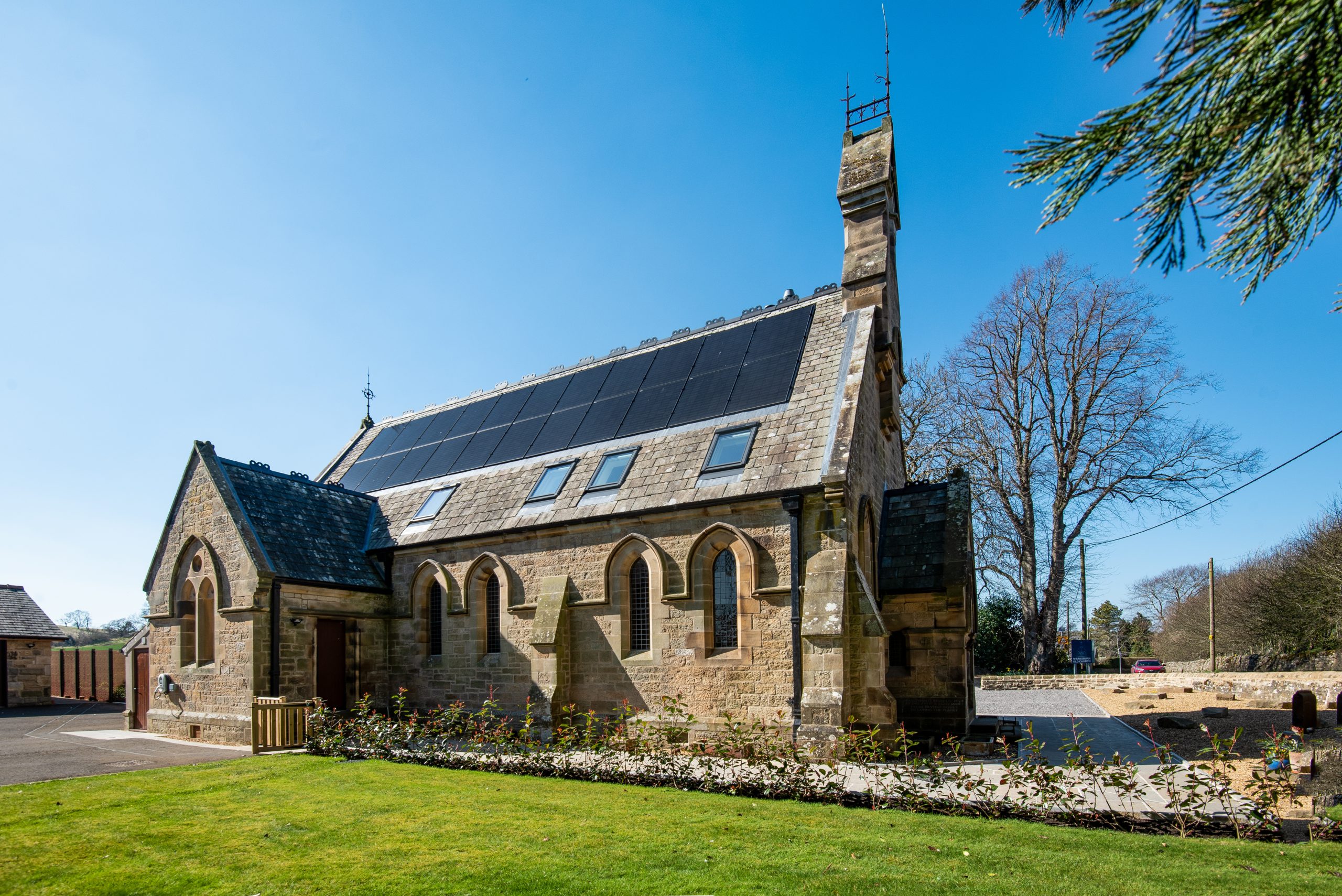
Energy Carbon’s low energy infrared heating was the system of choice to ensure optimal comfort in this incredible refurbishment Warksburn Old Church is a spectacular three bedroom luxury holiday rental property at Wark-on-Tyne, Northumberland, where breathtaking interior design is finished with exceptional attention to detail. It is located close to Hadrians Wall, Hexham, and Kielder in a beautiful and tranquil part of rural North East England. A £1M renovation during 2023/24 created a truly unique and stylish home, where up to six guests can enjoy a wonderful holiday. Sensitively updating a heritage building with cutting edge low carbon technology, the rebuilt Warksburn Old Church is one of the most efficient buildings in the UK, generating more energy than it consumes every year. It is the first church conversion in the world to create a home which meets the ultra-demanding Passivhaus standard for energy efficiency. Warksburn Old Church invites you to experience Net Zero Luxury for yourself. Low energy lighting is used in every room, and invisible ‘far infrared’ heating is physically built in to floors, walls, and ceilings within the property. This innovative technology provides exceptional comfort and warmth when cold winter’s days require it and means no more radiators are necessary. However, for most of the year, guests will notice that this Passivhaus building requires no heating at all, other than the heat naturally emitted by its occupants, and their activities such as cooking. This is both because it is super-insulated and also because it incorporates a Mechanical Ventilation & Heat Recovery (MVHR) system Plastering in was as simple as pressing the FLEECE into a wet bed of Multifinish plaster before polishing off ready to decorate as seen in this installation video. Smart energy providing guest comfort and facilities Generating electricity from a substantial solar array, carefully recessed into the 150 year old Westmorland slates on the south roof, and storing the energy produced in large batteries, Warksburn Old Church incorporates a number of smart energy technologies. These supply renewable or sustainable power for numerous features and facilities provided for the comfort, convenience, and enjoyment of guests. This stunning property, which is now available as an Airbnb, was featured on Discovery TV, The Sunday Times and Grand Designs Magazine.

Improve resident comfort and reduce energy costs in a care home
The new, smart way of improving resident comfort whilst saving energy in a care home? High energy bills, stale air, smells and unhappy people – time to put things right and reduce energy in a care home! Imagine the scenario if you will. A care home operates a centralised heating system such as a gas boiler or heat pump. Rooms are heated with a series of radiators/emitters which take up valuable wall space and can cause obstruction. These radiators dry the air out and circulate dust across the building, spreading smells, virus and other nasties. Then the boiler/heat pump breaks down, wreaking havoc across the home and activating the deployment of electric panel heaters. Now we have obstruction, dust, dry air AND high energy bills! Dry air and smells cause residents and care staff to open windows across the care home, further spreading the nasties from room-to-room, creating cross drafts and throwing around 30% of the valuable warmth out of the window. This foul air seeps into the building fabric. It slows everyone down and becomes quite a nasty place to live in, work in or to visit as a relative. Visits from outside become challenging as relatives can’t bear the thought of sitting around in these conditions – the smell and heat hitting them as they enter through the front door. Prospective clients visiting the home pick up on the heat, the drafts, the smell and the general lethargy of everyone struggling to carry out daily routines and think twice about placing their loved ones into the home. De-risking the building, improving resident care and saving energy – the future is now Okay, so this is a pretty desperate picture and, of course, not all homes are like this. However, these situations are reflected to some degree in most care homes – new or old. In fact, the author has an elderly mother in a 2 year old home with a heat pump and this very much reflects this position. Sitting with his Mother is challenging at the best of times (dementia) but the smell and dry air has scared off all other family members. Now picture this. A low energy, 36v, heating system embedded into the ceiling and emitting healthy far infrared light waves throughout the residents room – warming the floors, walls and surfaces as gently as the sunshine on a beautiful Spring day. There’s no heat convection and so no dust. Great for those with breathing difficulties. There’s no large, ugly emitter (radiator) on the wall and so a nice piece of personal furniture takes its place. Fitted into the wall of this room is a de-centralised ventilation system that provides constant fresh air whilst recovering 99% of the heat and using less than 1watt of electricity. It senses when CO2, moisture or air impurity levels are high and automatically purges the room – see our explainer video here. Both systems operate independently from all other rooms and so can be programmed to the residents personal requirements. There is no cross contamination of virus and dust and each room can be operated and monitored for the ideal climate whilst helping reduce energy in a care home. As the heating system is fast reacting, common areas may be zone controlled and drop back to a lower temperature when not in use, further saving energy. What about installation and maintenance? Both systems can be installed within a day to an average sized room and can form part of a decor upgrade. No more Engineer call outs in this home – the heating has no moving parts and requires no servicing for the life of the system – that’s in excess of 50 years. The ventilation system can be serviced by the cleaning crew as simply as changing a filter on a vacuum cleaner. So – less money spent on heating, less virus spread, happier staff and residents, more visits from relatives and more bookings from prospective customers. That’s a win all round. For further information and to see the systems in operation – pop over to stand F74 at the Care Show, London Excel 24th and 25th April or to see the Author talk about this in more detail then click HERE
Case study – far infrared ceiling and floor heating in a new build church and community centre
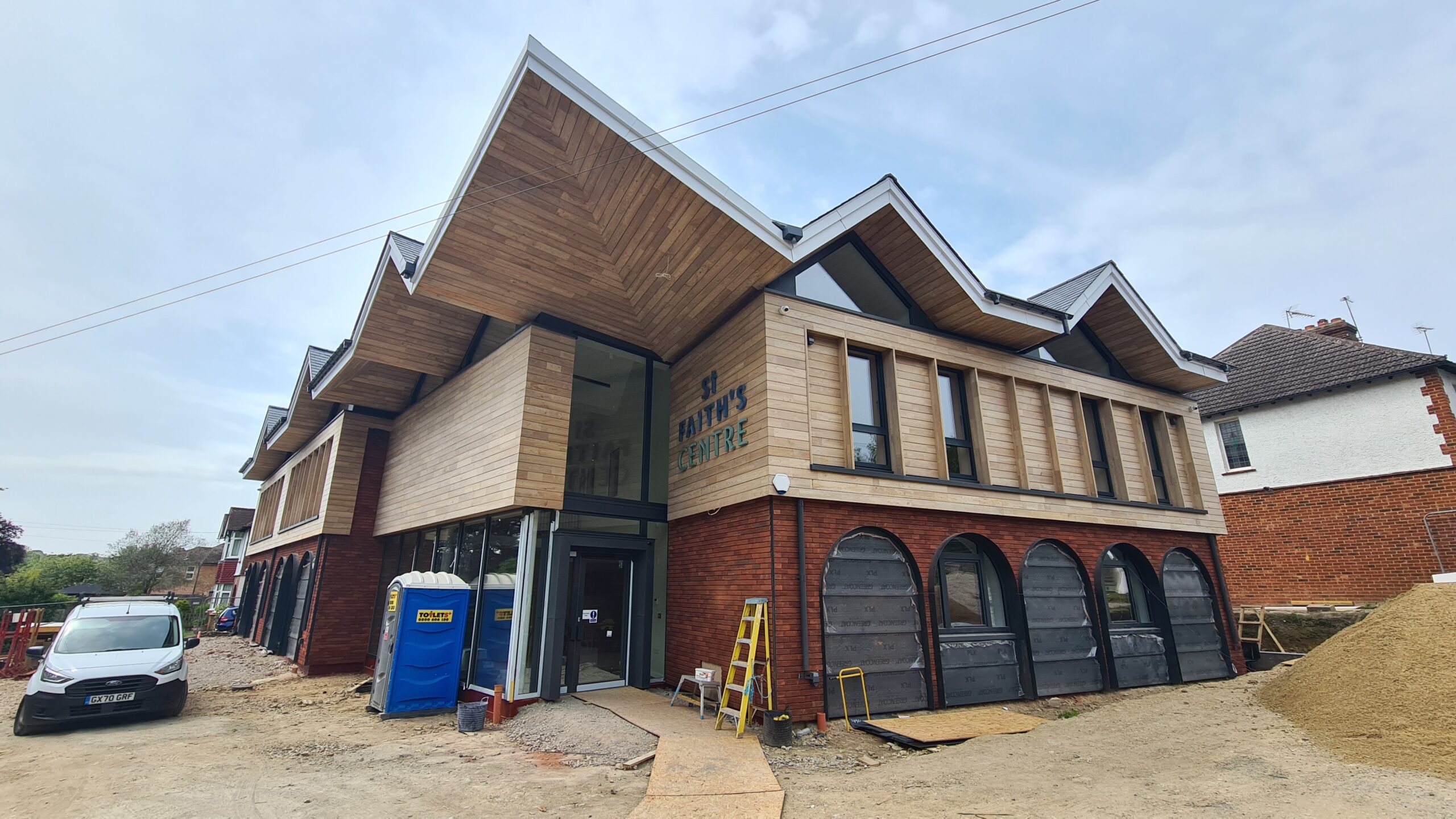
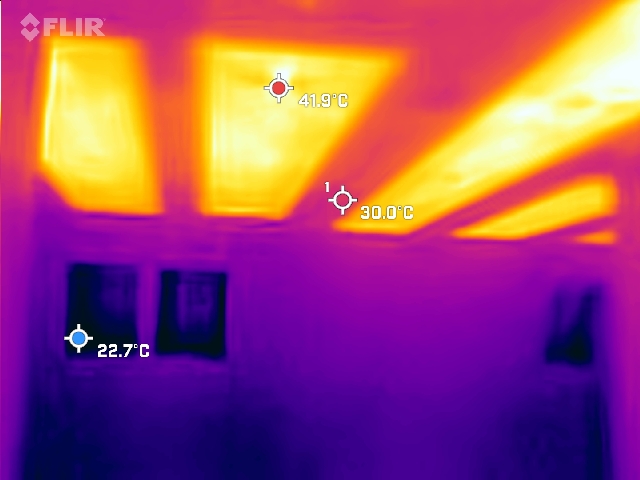
Eco heating was the heating of choice for this incredible new build project. This beautiful church and community centre replaced the old St.Faiths Church in Kent. The planning process for the building was long and arduous and fell by the wayside on many occasions until the Church approached Richard Hawkes of Hawkes Architecture – and so the journey began. Far infrared heating allows beautiful, uninterrupted design Hawkes are great believers not only in the design advantages that hidden infrared can bring to a project, allowing more space for great impact, but also in it’s energy saving and thermal comfort properties. Energy Carbon were selected from a choice of several manufacturers and installers as the best fit for this project. Design of the heating commenced with energy calculations to determine the predicted heat loss for the building. This is where infrared really wins out over other heating systems as there is no requirement to heat the air or ‘space’ but, instead, we heat the surfaces and occupants directly by providing an even coverage of around 30% to 60% in the ceiling. This effectively reduces the load on the building thus bringing down CAPEX and OPEX. The added benefit of surface heating is that the building is ‘charged’ with heat, a bit like a battery storing energy, which, in turn, releases to warm the air when the heating is turned off. Bringing the Team up to speed with this new technology After meetings and discussions with the main contractors Harry Barnes costings were produced which led onto producing detailed layout plans showing the layout of the mats. Due to the large ceiling height of the main hall we opted to place FLEECE mats under the engineered flooring here and also in the main reception. The rest of the project benefits from our FLEECE system fitted into the ceiling. The system has a heat load of just 14kw’s, not bad for a building of over 400m2! This was achieved by using our low energy, 60wm2 FLEECE product along with a series of just 5, 36v transformers feeding the 12 zones. Zoning along with efficient smart controls allow for detailed scheduling as well as preemptive heating as required, in readiness for group activities such as Toddler sessions or church meetings. The installation commences Electrics were carried out by the very capable team at Bexhill Electrical who, despite never having heard of the product before, carried out the install incredibly well and to a very high standard. Plastering in was as simple as pressing the FLEECE into a wet bed of Multifinish plaster before polishing off ready to decorate. Watch the heat come to life, live, on camera Finally, the project was fired up to test reaction time and heat output using a FLIR camera we used the FLIR One which simply attaches to a smartphone. For the full architectural design process click here
Let’s address some common concerns about infrared
We live in a world full of things that a hundred years ago the average person would’ve seen as bordering on magical. However, despite our huge versatility as a species, getting used to something new still takes time. In the decades ahead, we’re going to be introduced to a whole range of different products and technologies – many of them designed to help tackle the enormous, existential threat posed by climate change. The ‘r’ word At Energy Carbon, we specialise in infrared heating (specifically far-infrared, but we’ll get on to that in just a minute). Fast, effective and extremely easy to roll out across the country at scale, infrared heating can make a huge contribution to cutting the UK’s carbon footprint by replacing environmentally damaging gas boilers. But we know from experience that homeowners sometimes have questions and concerns about infrared. Infrared is a type of radiation – a word which, understandably, makes some people uneasy. So let’s go back to basics and explore exactly what it means. Radiation is simply energy that moves from one place to another. In other words, it ‘radiates’ from a source to somewhere else. There are two types of radiation – ionising radiation and non-ionising radiation. Ionising radiation has the potential to disrupt the atoms in the human body, and can therefore be harmful to people’s health. It’s this radiation – like the kind emitted by nuclear material – that’s given the r-word its unpleasant reputation. Infrared is everywhere But infrared is a kind of non-ionising radiation – and is in fact something every human being, and almost every living creature, is exposed to and benefits from every day. The light from the sun is 49% infrared radiation, for example. Now, at this point, you might be thinking – sunlight is very nice and all, but isn’t it also dangerous in some contexts? As we all know, if people go out in the sun for too long and too often without taking the right precautions, they can suffer health issues as a consequence. This is true, but that’s because the sun also produces UV – a type of radiation which is very useful in some respects (it’s one of our main sources of Vitamin D), but can still be harmful in large amounts. Far infrared However, that’s not to say that all infrared is safe. There are actually three types of infrared radiation – near infrared, mid infrared and far-infrared. Near infrared has the lowest bandwidth of the three – and the lower the bandwidth, the more it excites our atoms. That means it has the potential to burn, and exposure to near infrared has been found to burn the retinas of the eyes. Far-infrared, by contrast, is completely safe. It’s known as the ‘light of life’ – we said earlier that 49% of the light from the sun is infrared. To be precise, it’s far-infrared (it’s also far-infrared that’s used in incubators to warm new-born babies). And it’s far-infrared that’s by far the most beneficial for heating homes and its occupants. Far-infrared radiation warms all the surfaces and objects in a room, rather than the air – and those surfaces and objects then go on to radiate heat themselves. The embodied heat gathered in these areas slowly releases back into the room, allowing for very fast reaction times, which mean the heating itself doesn’t have to be on and consuming electricity for as long before homeowners start to feel the benefit – cutting both energy bills and carbon footprints. But not all far-infrared heating is created equal. In the past, many manufacturers have produced far-infrared heating panels that are commonly placed on the walls or ceilings inside the home. However, these panels become extremely hot to the touch when they’re in operation – which makes the dangerous if children, elderly people or anyone else accidentally fall against them. This heat becomes very uncomfortable when placed overhead and they also only heat specific areas in a room such as over a dining table – get up from your chair and you’ll feel cold again. At Energy Carbon, we are infrared heating suppliers and provide a much better and safer solution – far-infrared heating fleece, made from recycled materials, that can be plastered into walls or ceilings, or, in the case of our newest product Drytec, inserted behind the plasterboard without the need for wet trades. The 36v product covers 60% of a ceiling area, radiates out to 100% of the floor area and operates at a surface temperature of around 35° World-changing potential Like any new technology – or in this case, a new use for a technology that’s been around for years – far infrared heating may take a bit of getting used to. But once we’re over that hurdle, it’s going to play a massive part in making Britain a much greener, more sustainable place to be.
Retrofitting a property needn’t be a headache using our IR Fleece for the heating
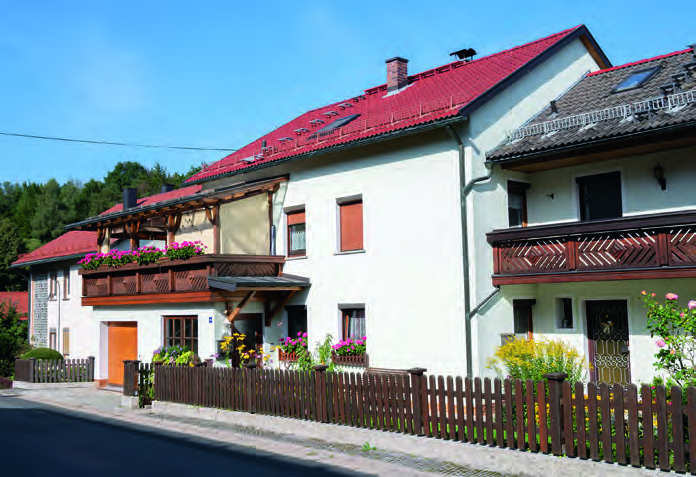
In the two-family house (built in 1962), the upper floor flat was renovated. The house, originally equipped with night storage heaters, was to continue to be heated with electricity at the owner‘s request, so the E-NERGY CARBON FLEECE system was used as ceiling heating. This meant that the flat could continue to be occupied during the entire construction phase. To optimise energy costs, a PV system on the roof will support the overall installation in the future. Ceiling plaster: Multi Finish Surface heating: E-NERGY CARBON FLEECE (110 wm2) Surface: 150 m² Area: Upper floor